
HBOT for rehabilitation
Hyperbaric chambers for physical therapy clinics
PT clinics sit where rehab meets wound care, and HBOT fits the practice two ways: a cash-pay recovery service line alongside physical therapy, and a physician-supervised wound-care program on the FDA-cleared, insurance-covered indication. Different chamber, different room, different claims. Here is the evidence, the regulatory line, and the equipment math.
The fit
Why physical therapy clinics are adding HBOT
Few buyer profiles match hyperbaric oxygen therapy as directly as a physical therapy practice: the case mix already overlaps both of HBOT's worlds.
A hyperbaric chamber dissolves extra oxygen directly into blood plasma under pressure, delivering it to tissue that circulation alone supplies poorly: healing surgical sites, strained muscle and tendon, and oxygen-starved wounds (Mayo Clinic). That mechanism maps onto the two halves of a typical PT caseload. On the rehab side: post-surgical orthopedic recovery, sports and soft-tissue injuries, and structured return-to-training blocks. On the wound side: diabetic ulcers and non-healing wounds, the indication where HBOT is FDA-cleared and insurance-covered. The ATA pressure ladder shows what each pressure tier delivers.
The business timing fits too. Reimbursement pressure on PT visits has clinic owners building cash-pay ancillary services, and HBOT is structurally suited to the models PT practices already run: it is a scheduled, multi-session modality sold in packages and memberships, delivered on equipment with a 20 to 30+ year service life. The result is a service line that deepens care for patients you already treat while adding revenue that is not tied to visit-based billing.
The organizing decision
Two ways to add HBOT to a PT clinic
Everything downstream, the chamber, the room, the staffing, the marketing, follows from which of these two businesses you are building. Most clinics start with the first and grow referral relationships around the second.
| Line A: cash-pay recovery adjunct | Line B: medical wound care | |
|---|---|---|
| Who pays | The patient: cash-pay sessions, packages, memberships | Medicare and commercial insurers, when coverage criteria are met |
| Clinical frame | Recovery and performance support alongside PT: post-surgical recovery, sports soft-tissue injury, return-to-training blocks | Physician-prescribed adjunct for covered indications, anchored by Wagner grade III+ diabetic foot ulcers after failed standard care |
| Device requirement | Wellness-positioned hard-shell chambers up to 2.0 ATA | FDA-cleared Class II chamber, 2.0–2.4 ATA with 100% oxygen |
| Supervision | Trained chamber attendant on site; state rules vary | Physician supervision; accredited-facility expectations |
| Claims you can make | Wellness, recovery, and performance language only | Medical claims within the device labeling and the covered indication |
| Revenue profile | Package revenue from your existing patient base, $100 to 250 per session market rate | Reimbursed courses of 30–40 sessions; Medicare pays about $595.86 per session in 2022 data for qualifying wounds |
Line A is where most PT clinics start, and it is the line our chambers are built for. Your existing patients are the market: post-surgical and sports injury cases already on your schedule, plus the local athletes and active adults a recovery membership attracts. The claims discipline is simple and we hold it on our own pages: wellness, recovery, and performance language, no medical promises. The athletes pillar covers how that recovery market buys.
Line B is a genuinely strong business, run as a medical program. Wound care is the FDA-cleared, Medicare-covered anchor of hyperbaric medicine, with defined reimbursement and structured 30 to 40 session courses. It also runs on FDA-cleared devices under physician supervision, which is a different hardware and regulatory path than wellness-positioned equipment. The section below maps what that path requires, and our medical-grade decoder explains the regulatory vocabulary in full. If your intended use is medical, talk to us: we review that separately, clinic by clinic.
No hype, no hedging
What the evidence says for rehab patients
A credible clinic sets expectations from the literature, including the parts that argue for good patient selection. Here is the honest grade of each PT use case.
| PT use case | Evidence base | What it supports |
|---|---|---|
| Muscle injury and soft-tissue recovery | 2025 systematic review & meta-analysis, 10 articles, 299 subjects | Significant benefit for exercise-induced muscle injury recovery. The strongest rehab signal in the literature |
| Post-surgical and peri-operative recovery | 2020 systematic review of peri-operative RCTs (Boet et al.) | The most common PT-clinic application in practice; the formal research base is still developing, so protocols run on clinical judgment and patient selection |
| Single-session effects | 2024 double-blind RCT, 20 elite youth footballers | One 60-minute post-match session improved perceived recovery without significantly changing biochemical or performance markers. Series beat one-offs |
| Soreness and DOMS | 2025 meta-analysis + Cochrane review, 219 participants, 9 trials | No clear overall benefit. Set patient expectations around tissue injury and recovery blocks, not routine soreness |
| Neuro rehab referrals (TBI, concussion, stroke) | Active research area; our condition pillars review it study by study | Encouraging results in selected patients; off-label and cash-pay in an outpatient PT setting, best run with physician involvement |
| Chronic wounds and diabetic ulcers | FDA-cleared, UHMS-listed, Medicare-covered (NCD 20.29) | The established, reimbursable indication. The full evidence review lives in our wound-healing pillar |
Read as a whole, the literature gives a clinic a clear playbook. The 2025 meta-analysis found HBOT significantly aided recovery from exercise-induced muscle injury, and positive findings across the literature cluster around repeated 2.0 ATA protocols, which is both an equipment decision and a scheduling decision. The same analysis found no clear benefit for routine soreness, and the older Cochrane review on DOMS reached a similar verdict, so build the service around tissue injury and recovery blocks rather than everyday aches. For post-surgical patients, the most common PT-clinic application in practice, the formal trial base is still developing (Boet 2020), which is why protocols run on physician judgment and sensible patient selection; our post-surgical evidence guide tracks that literature, and the athletic recovery research review covers the sports-injury side study by study.
The neuro rehab rows deserve their own reading: TBI and brain injury and stroke recovery are active research areas with encouraging results in selected patients, reviewed study by study in our condition pillars (with the concussion and stroke recovery evidence guides as the shorter reads). Wound care, the sixth row, is the established reimbursable indication, and it gets the next section to itself.
The reimbursable anchor
The wound-care side: what coverage actually looks like
Chronic wound care is the strongest, most structured business case in hyperbaric medicine: a cleared indication, defined reimbursement, and courses measured in weeks of daily sessions.
Medicare's NCD 20.29 covers HBOT for diabetic lower-extremity wounds when the wound is Wagner grade III or higher, has failed an adequate course of standard wound therapy (debridement, offloading, infection control, moist dressings, glucose management), and HBOT is delivered in addition to that standard care, with measurable healing required in every 30-day window. Medicare pays about $595.86 per session, courses typically run 30–40 daily sessions, the facility bills HCPCS G0277 in 30-minute increments, and the supervising physician bills CPT 99183. Compromised grafts and flaps and delayed radiation injury are covered under their own criteria, and the UHMS indications list maps the full landscape.
Two requirements define who can run this line. The therapy must be delivered on an FDA-cleared Class II chamber (cleared, not approved: the FDA's consumer guidance is exact on this vocabulary), and it runs under physician supervision with accredited-facility expectations. That is a different equipment and regulatory path than wellness-positioned chambers, and it is why many PT clinics serve their wound patients through referral relationships with wound centers while building Line A in-house. The full evidence review lives in our wound-healing pillar and the wound healing evidence guide, the billing mechanics in the CPT 99183 guide and the insurance coverage pillar, and the device vocabulary in the FDA-cleared indications guide. For clinics that want to scope the medical path directly, we review medical intended use separately.
The equipment decision
Which chamber fits a PT clinic
One question sorts it: does the chamber serve one patient at a time in a converted treatment room, or cycle several patients per hour as a dedicated service line?
Pressure comes first. The rehab protocols the positive findings cluster around run at 2.0 ATA, which is hard-shell territory; every Superhuman hard-shell chamber reaches a true 2.0 ATA, built in an ASME-certified factory, independently pressure-tested to PVHO-1 standards, and manufactured under ISO 13485 and ISO 9001 quality systems. Soft-shell chambers at 1.3 to 1.5 ATA serve the home and entry wellness market; they are not the tier a clinical service line is built on.
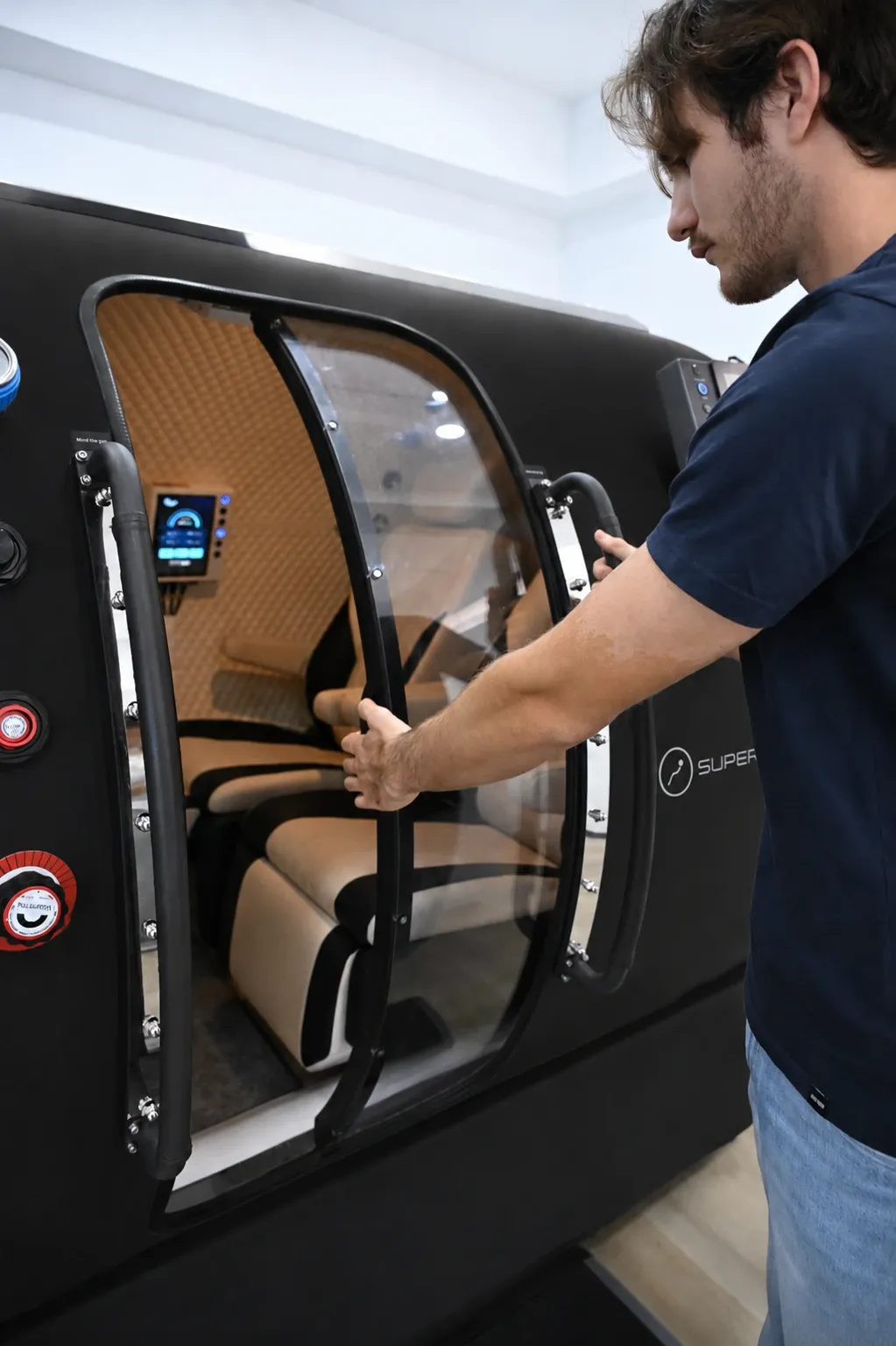
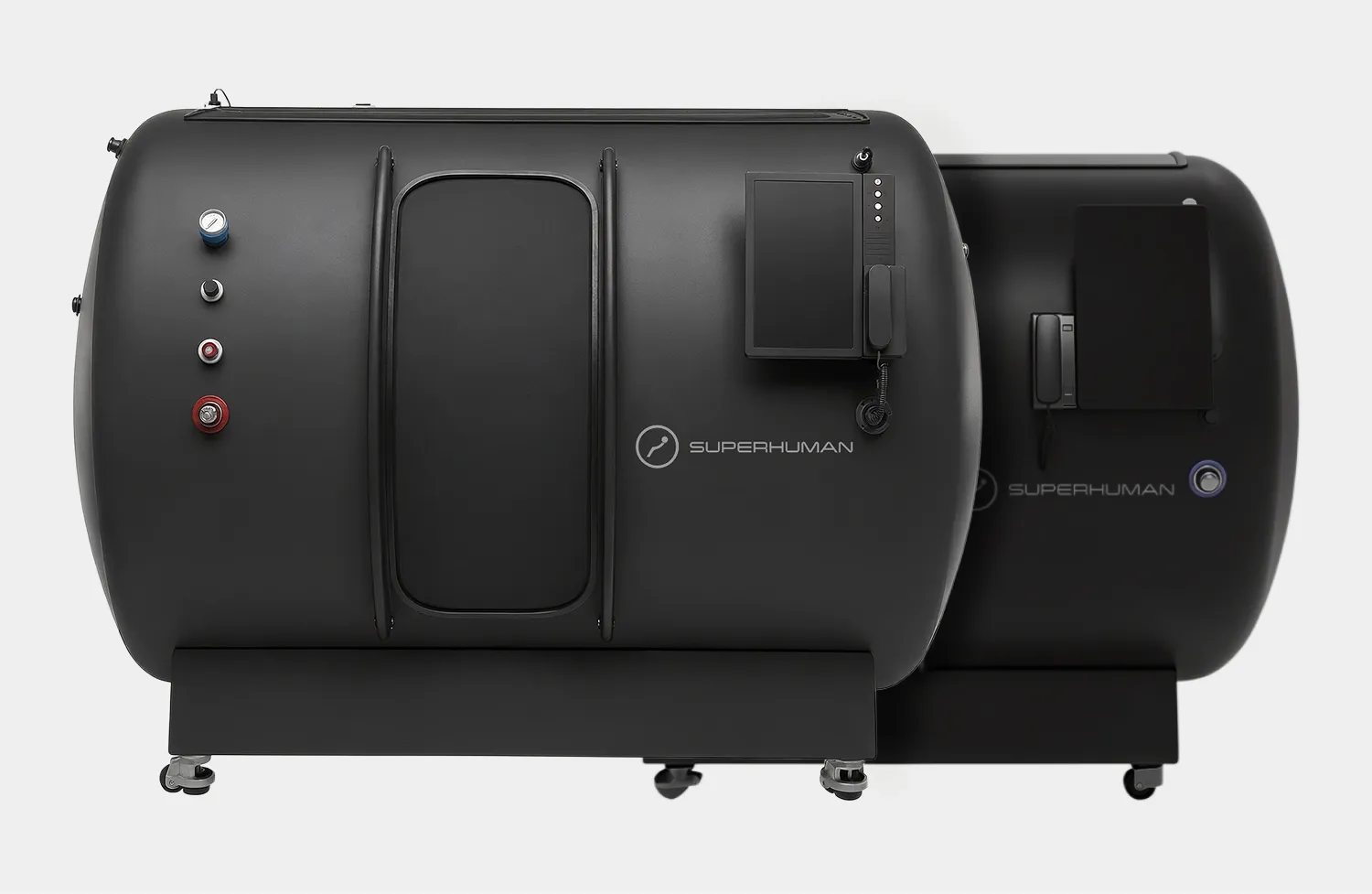
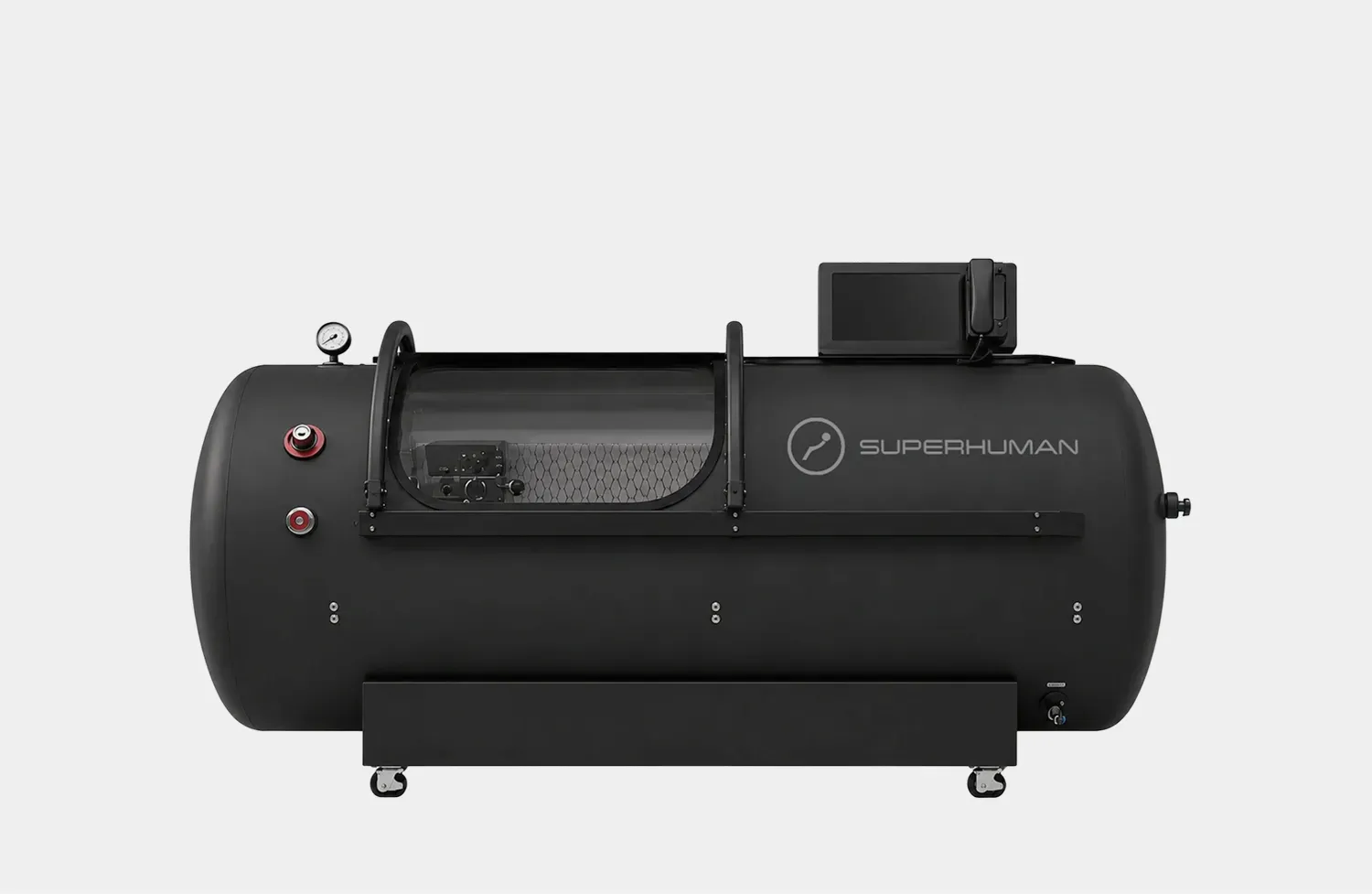
Then throughput. A monoplace chamber matches the classic PT schedule: one patient, one room, one session slot. The L1 ($49,000) installs in a standard spare room footprint on a standard outlet, and the seated X ($110,000) is the premium single for a flagship room. A multi-seat chamber changes the economics of the same hour: the T2 ($125,000) treats two patients per session and the T4 ($169,000) four, with flexible layouts including a bed mode for post-surgical patients who cannot sit comfortably, quiet operation at conversation level, and a duty cycle built for back-to-back daily schedules.
The practical checklist
Room, power, and staffing
The site requirements are more modest than most owners expect, and every line item below already has a detailed guide on this site.
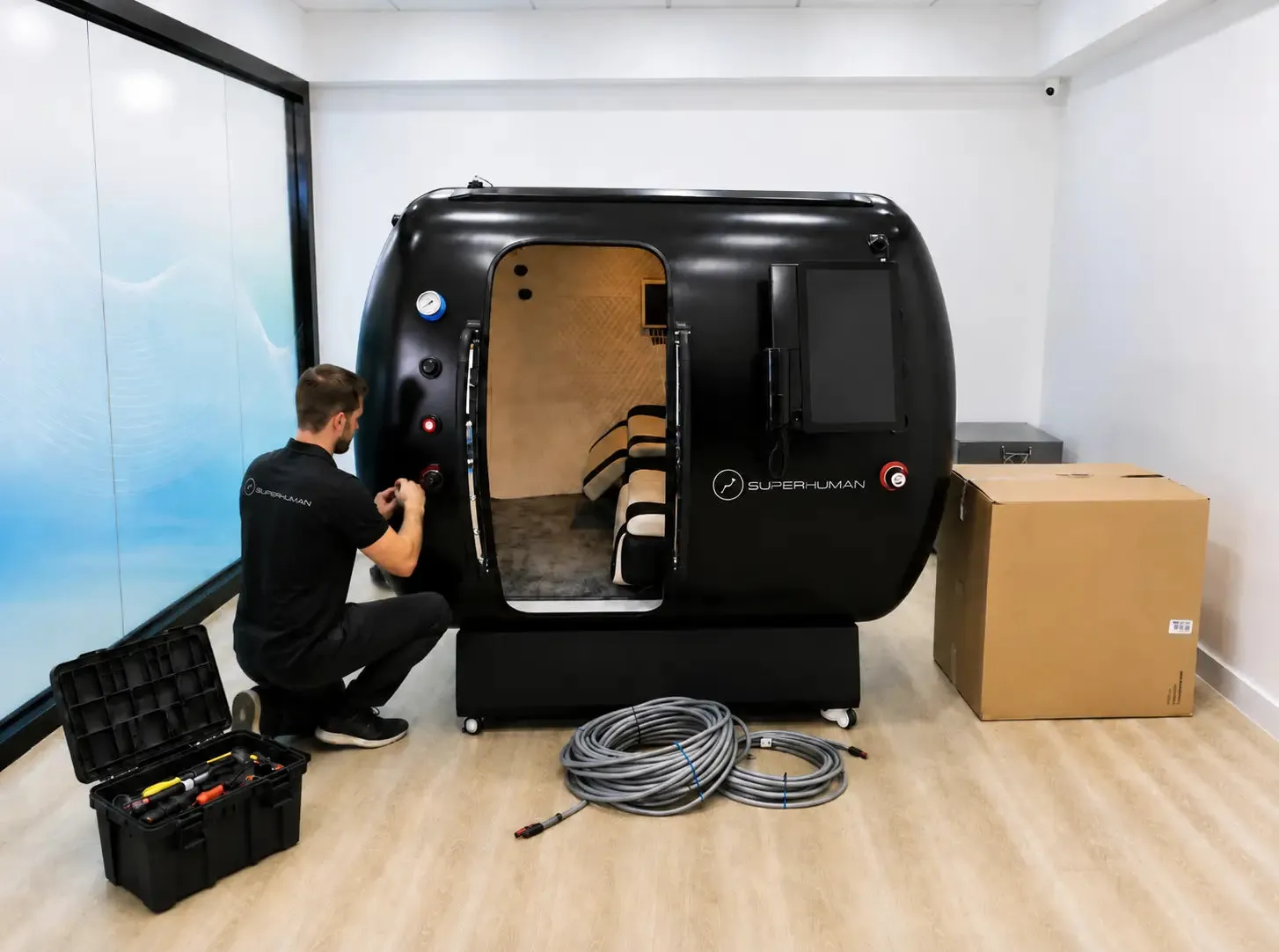
Space and power. The L1 fits under 2.5 m of floor length and runs on a standard 110V to 240V outlet, with the compressor, oxygen concentrator, and air dryer combined in one compact side unit, so there are no tanks or refills. The T2 and T4 need roughly 1.8 m of ceiling and a 2.1 to 2.3 m by 1.7 m footprint; floor loading is reviewed during the site assessment before delivery, and white-glove installation with on-site training is included. Clearances, ventilation, and local review are covered in the installation pillar and our clinic room requirements guide, including the NFPA 99 facility context and the states that reference ASME PVHO-1.
People and paperwork. A trained attendant is present during sessions; our technician certification page and the operator licensing guide map the training options, and our team walks your staff through operation at install. Insurance needs one specific action: a hyperbaric rider on the clinic's liability policy, confirmed in writing before the first session, which our business insurance and liability guide covers line by line. Rules on supervision and purchase vary by state and use case, so confirm your state's requirements before signing; the prescription guide and the safety pillar lay out that landscape honestly.
The economics
The business math for a PT clinic
Clinics charge $100 to 250 per session and sell HBOT in packages of 10 to 20. Against that, the chamber is a fixed, long-lived asset with minimal running costs.
Start with revenue. Multi-session packages are both the better clinical model (the evidence favors repeated sessions) and the better business model: a 10 to 20 session package at $100 to 250 per session is a $1,000 to $5,000 commitment per patient, drawn largely from the post-surgical and sports-injury caseload you already treat. As an illustration: a two-seat chamber running six back-to-back cycles a day at 60 percent seat fill and a $125 average package rate grosses roughly $900 a day, about $20,000 a month. A four-seat T4 doubles the seat count on the same daily schedule.
Against that revenue, costs are fixed and modest: about $1.50 of electricity per session, $200 to 300 a year in filters, and a 304 stainless vessel built for a 20 to 30+ year lifespan. We publish our prices openly, $49,000 to $169,000 across the hard-shell lineup, because the traditional medical-chamber market, where monoplace units are commonly quoted at $200,000 to $300,000, usually does not. Financing spreads the purchase into a monthly payment that package revenue is designed to exceed, and the cost guide and the five-year cost calculator run the numbers for your schedule. The full operator model, including marketing and utilization planning, is mapped in the hyperbaric chamber business guide and the guided for-business path.
Which Superhuman
The lineup through a PT clinic's lens
Every model below is hard-shell 2.0 ATA, ASME-certified and PVHO-1 pressure-tested, with white-glove installation and lifetime remote support included.
| Model | Best fit | Pressure | Seats | Price |
|---|---|---|---|---|
| L1 | Converted treatment room, one patient per session | 2.0 ATA | 1 | $49,000 |
| X | Premium seated single for a flagship room | 2.0 ATA | 1 | $110,000 |
| T2 | Two patients per session, core service line | 1.5–2.0 ATA | 2 | $125,000 |
| T4 | Four patients per session, high-throughput practice | 1.5–2.0 ATA | 4 | $169,000 |
One patient, one room, one slot
- Fits a converted treatment room on a standard 110V–240V outlet
- L1 at $49,000, or the seated X at $110,000 for a flagship room
- True 2.0 ATA, the tier the rehab protocols cluster around
- The lowest-risk entry into the recovery service line
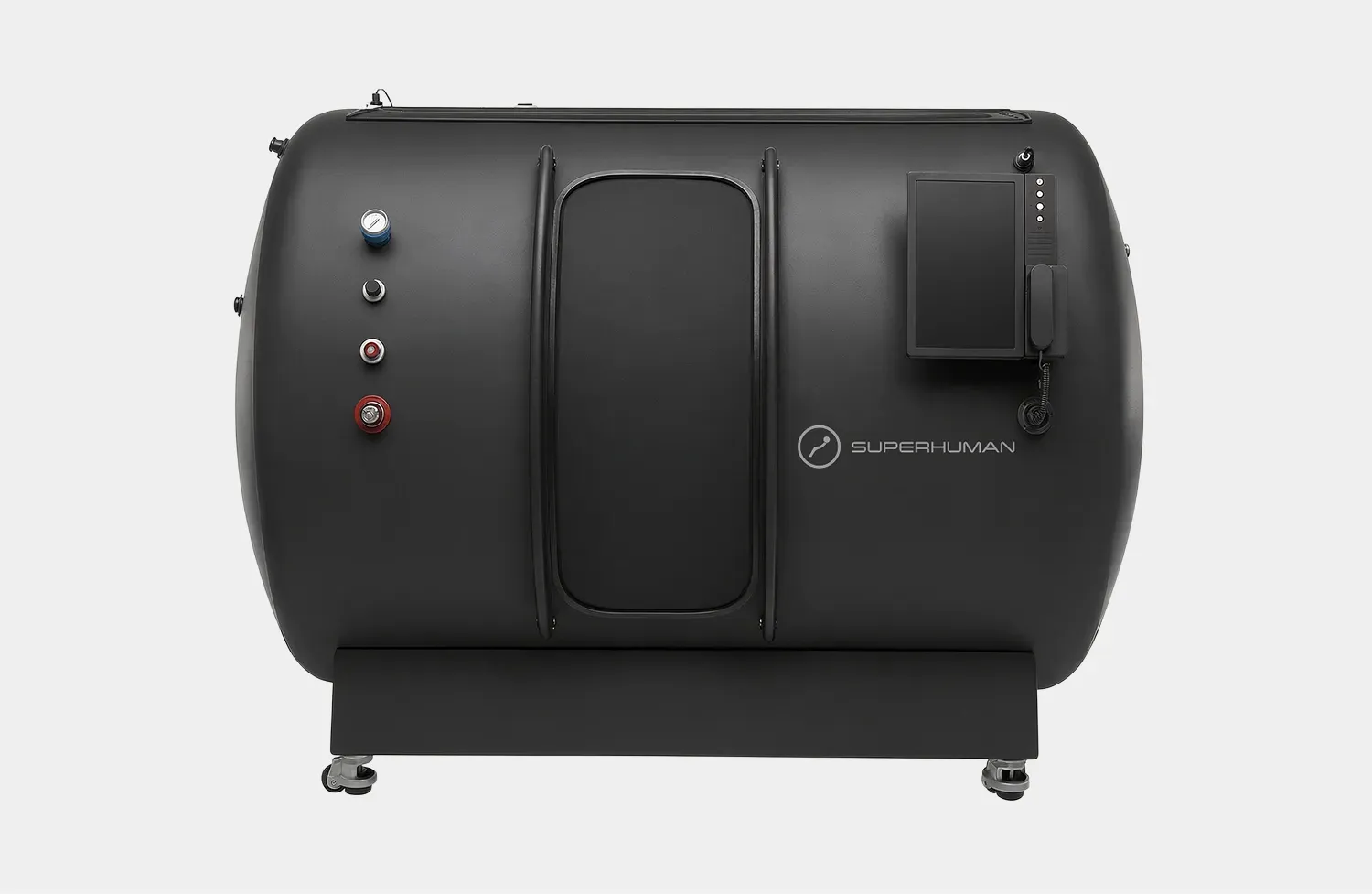
Two to four patients per session
- T2 seats two at $125,000, T4 seats four at $169,000
- Bed mode for post-surgical patients who cannot sit
- Built for back-to-back cycles all day, quiet at conversation level
- The same hour treats a whole schedule block, not one patient
Whichever direction fits your schedule, the diligence path is the same: verify the pressure tier against the evidence summary above, scope the room with our installation team, and run your own numbers in the cost calculator. Browse the full range in chambers for sale, or book a consultation and we will map the service line to your case mix together.
FAQ
PT clinic questions
Should a physical therapy clinic add a hyperbaric chamber?
If your case mix includes post-surgical orthopedic patients, sports and soft-tissue injuries, or athletes in structured return-to-play blocks, HBOT is one of the more natural ancillary service lines a PT clinic can add: it is a multi-session modality that slots directly into the package and membership models clinics already run. The research signal is strongest for tissue injury recovery under repeated 2.0 ATA protocols, which matches exactly that patient mix. Clinics with a wound-heavy referral base have a second, insurance-covered path, but that is a medical program with its own device, supervision, and accreditation requirements. The right starting question is your last 12 months of case types, not the equipment catalog.
What can a physical therapy clinic honestly offer HBOT for?
Two distinct things. As a cash-pay service, clinics offer recovery and performance support alongside PT: post-surgical recovery, sports soft-tissue injury, and training-block recovery, framed in wellness and recovery language. That is a real and growing practice, and it is off-label, so the honest frame is recovery support, not medical treatment promises. As a medical service, HBOT is FDA-cleared and insurance-covered for specific indications, anchored by Wagner grade III+ diabetic foot ulcers that have failed standard care. That path runs on FDA-cleared devices under physician supervision. Most PT clinics start with the recovery service line and build wound-care referral relationships rather than launching a medical program on day one.
Does insurance reimburse HBOT in a physical therapy clinic?
Under the medical wound-care model, yes. Medicare's NCD 20.29 covers HBOT for diabetic lower-extremity wounds that are Wagner grade III or higher, have failed an adequate course of standard wound therapy, and receive HBOT as an adjunct to that standard care, with measurable healing required in every 30-day window. The facility bills HCPCS G0277 in 30-minute increments and the supervising physician bills CPT 99183; Medicare pays about $595.86 per session, and typical courses run 30–40 sessions. Coverage attaches to FDA-cleared devices under physician supervision. Cash-pay recovery sessions are not billed to insurance at all, which is why the recovery service line is modeled on package pricing. Our insurance coverage guide and CPT 99183 guide carry the full mechanics.
Monoplace or multiplace: which chamber type fits a PT clinic?
It depends on your schedule density. A single-occupant chamber fits the classic PT model: one patient, one room, one session slot, and the L1 installs in a converted treatment room on a standard outlet. A multi-seat chamber changes the economics of the same hour: the T2 treats two patients per session and the T4 four, both at 2.0 ATA, with flexible layouts including a bed mode for post-surgical patients who cannot sit comfortably. Clinics that expect the chamber to run back-to-back through the day usually shortlist the multi-seat pair; clinics piloting the service line often start with a single and grow into throughput. Our monoplace and multiplace guides compare the architectures in detail.
What space and power does a hyperbaric chamber need in a clinic?
Less than most owners expect. The L1 fits a standard spare room footprint, under 2.5 m of floor length, and runs on a standard 110V to 240V outlet, with the compressor, oxygen concentrator, and air dryer combined in a compact side unit. The multi-seat T2 and T4 need roughly 1.8 m of ceiling and a 2.1 to 2.3 m by 1.7 m footprint, run quietly at conversation level, and have floor loading reviewed during the site assessment that comes before delivery. White-glove installation and on-site training are included. The installation pillar and our clinic room requirements guide cover clearances, ventilation, and local review in detail.
How much does a clinic chamber cost, and how does the payback work?
Across the hard-shell lineup: the L1 single is $49,000, the seated X is $110,000, the two-seat T2 is $125,000, and the four-seat T4 is $169,000, all at 2.0 ATA with white-glove installation included. We publish prices openly because the traditional medical-chamber market, where monoplace units are commonly quoted at $200,000 to $300,000, usually does not. On the revenue side, clinics charge $100 to 250 per session and sell packages of 10 to 20. As an illustration: a two-seat chamber running six back-to-back cycles a day at 60 percent seat fill and a $125 average package rate grosses roughly $900 a day, about $20,000 a month, against running costs of about $1.50 of electricity per session plus $200 to 300 a year in filters. Financing spreads the purchase into a monthly payment that package revenue is designed to exceed; the cost calculator runs your own numbers.
Do you need a physician or special certification to run a chamber in a clinic?
It depends on your state and on which service line you run, so confirm your state's rules before purchase, not after. For the cash-pay recovery line, the consistent requirements are a trained attendant present during sessions, documented screening and operating procedures, and a liability rider on your clinic's insurance policy, which standard malpractice policies often exclude until you add one. Formal operator training and certification exist and are worth budgeting for; our technician certification page and operator licensing guide map the options. The medical wound-care line adds physician supervision as a structural requirement. Our guides on prescriptions and business liability cover the regulatory landscape honestly, including where rules genuinely vary.
Can PT clinics use HBOT for stroke or TBI rehab referrals?
This is an active and genuinely interesting research area, and some clinics build referral relationships around it, but the honest frame matters: HBOT for traumatic brain injury, concussion, and stroke recovery is off-label, the evidence is still maturing, and in an outpatient PT setting it runs as a cash-pay adjunct, best delivered with the patient's physician aware and involved. Our TBI and stroke pillars review the literature study by study, including the negative trials, and our concussion and stroke recovery evidence guides summarize what a clinic can responsibly say. Positioned honestly, neuro recovery is a credible long-term growth area for a PT practice; positioned as a promise, it is exactly the marketing that damages clinics.
Last updated: September 2026. This guide is educational and does not replace medical advice. Clinical use of hyperbaric oxygen therapy belongs in physician-directed care; consult a qualified physician for any medical application.