
The definition, in plain terms
What is a hyperbaric chamber?
A hyperbaric chamber is a sealed, pressure-rated vessel that raises the air pressure around you to 1.3 to 3.0 ATA so you can breathe up to 100% oxygen, two to three times more than normal air delivers. Clinics use it to treat about 13 FDA-cleared conditions (the UHMS recognizes 15); people also own one for recovery and wellness. Here is what it is, what it looks like, its types, the pressure that separates them, and what it costs.
The short answer
A pressurized vessel for breathing oxygen
Strip away the medical language and a hyperbaric chamber is a sealed container you pressurize. That is the whole idea, and everything else follows from it.
The air around you is roughly 21% oxygen at one atmosphere of pressure (1 ATA). A hyperbaric chamber seals you in and raises that pressure to 2 to 3 ATA, the equivalent of being 10 to 20 metres underwater, while you breathe close to 100% oxygen. Under that pressure, far more oxygen dissolves into your blood than breathing at sea level ever allows (Mayo Clinic).
The device goes by several names, hyperbaric chamber, hyperbaric oxygen chamber, and HBOT chamber, but they all describe the same hardware. The treatment delivered inside it is hyperbaric oxygen therapy; this page is about the chamber itself. For the underlying physiology, the National Library of Medicine keeps a peer-reviewed overview.
Why the pressure matters
What a hyperbaric chamber does to the body
Every effect traces back to one mechanism: pressure dissolves oxygen into the plasma, where it reaches places red blood cells alone cannot. The graded, evidence-by-evidence version is in our hyperbaric chamber benefits guide.
What it looks like
Inside a chamber, and what a session is like
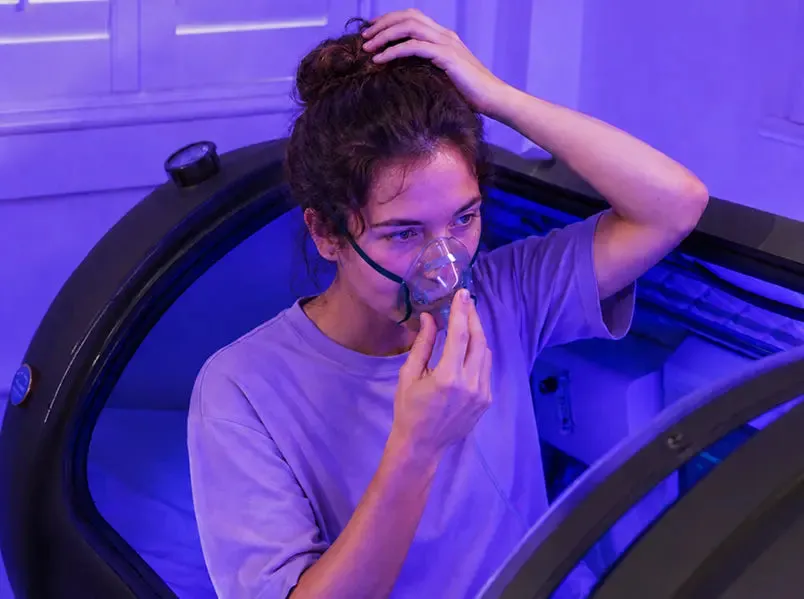
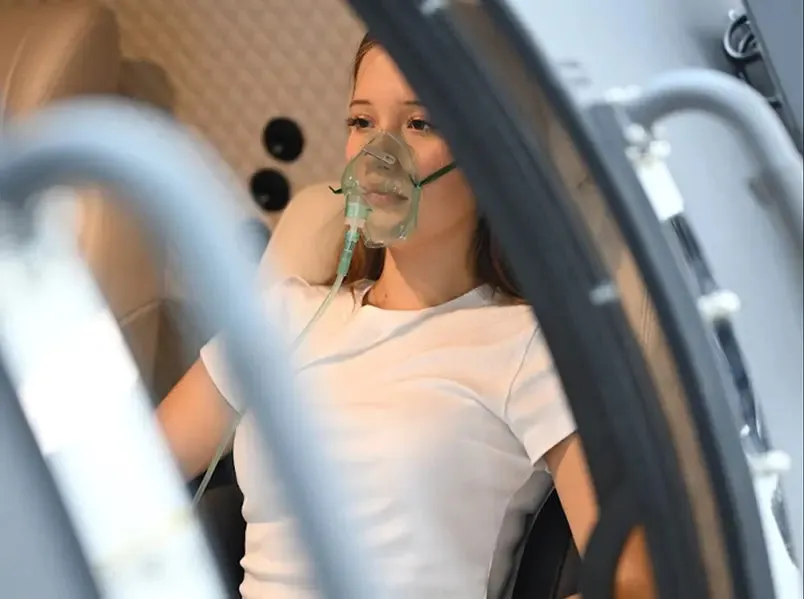
A hyperbaric chamber takes one of three physical forms, but the routine inside is much the same: it seals you in, raises the pressure over a few minutes, and holds it for an hour or two while you rest.
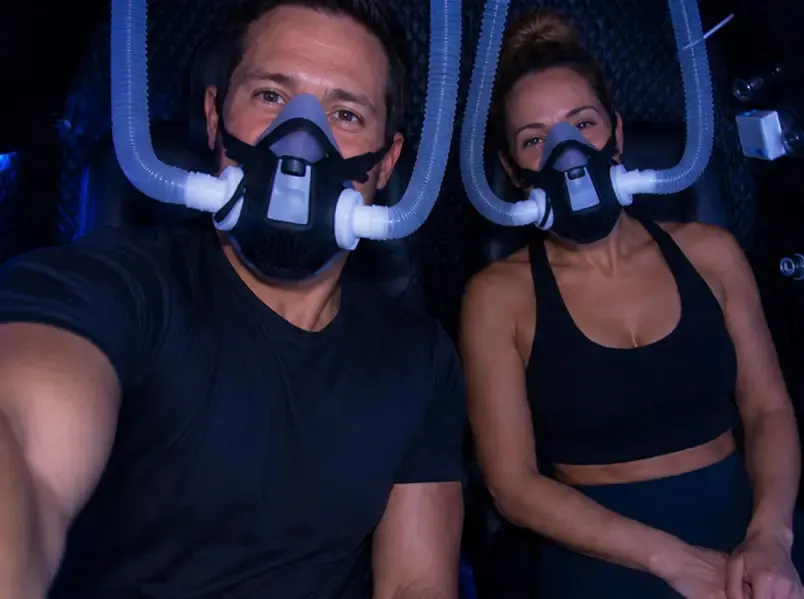
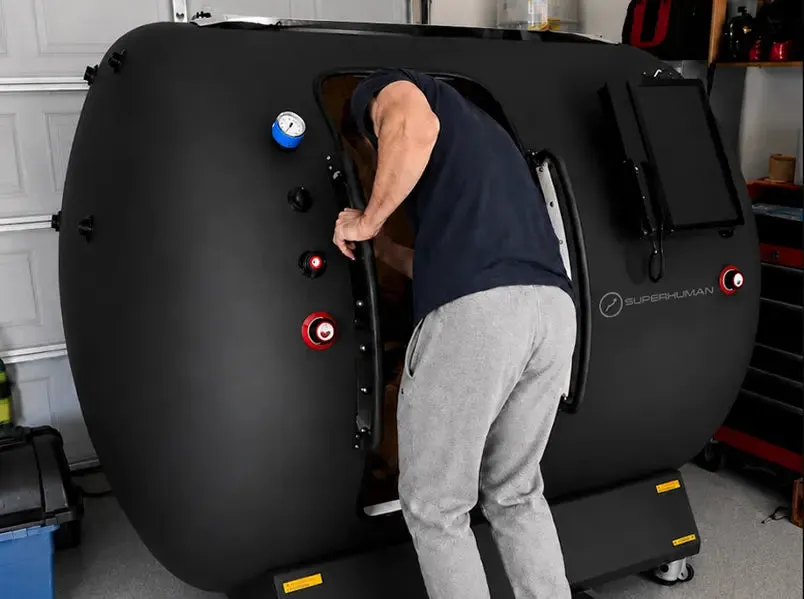
A single-person chamber looks like a long, clear acrylic tube you lie down inside, much like an MRI machine; a multi-person chamber is a room you walk into and sit up in; a soft-shell home unit is a zip-up, cylindrical tent of flexible material. Whichever the format, a session usually lasts 60 to 120 minutes, and you simply lie or sit and breathe normally, reading, sleeping, or watching a screen while the pressure does the work.
As the chamber pressurizes, it produces a faint hiss and a fullness in your ears, exactly like a plane descending; swallowing or yawning clears it. At the end, the chamber releases the pressure slowly and your ears settle. New to it? Our guide to your first HBOT session walks through it minute by minute, and Johns Hopkins keeps a clinical description of the experience.
The types
Types of hyperbaric chambers
Chambers are grouped two ways. Clinics split them by capacity, monoplace and multiplace; buyers split them by build and pressure, hard-shell and soft-shell. Both matter, so here is each side by side.
By capacity: monoplace vs multiplace
| Monoplace | Multiplace | |
|---|---|---|
| Holds | One person | Two or more, plus an attendant |
| How oxygen is given | The whole chamber fills with 100% oxygen | You wear a mask or hood; the room itself is air-pressurized |
| Looks like | A clear acrylic tube you lie inside | A room you walk into and sit up in |
| Typical setting | Outpatient clinics and home units | Hospitals treating critical or multiple patients |
By build: hard-shell vs soft-shell
| Hard-shell | Soft-shell (mild) | |
|---|---|---|
| Pressure | 2.0 to 3.0 ATA | 1.3 to 1.5 ATA (mild HBOT) |
| Oxygen | 100% medical-grade O₂ | Concentrated air (~90–95% via mask) |
| Build | Rigid steel or acrylic pressure vessel | Flexible polyurethane / canvas, zips shut |
| FDA status | FDA-cleared for 13 conditions (UHMS lists 15) | Cleared only for acute mountain sickness |
| Best for | Clinical protocols; serious recovery | General wellness; portable home use |
In our own lineup that split is the Superhuman S1, a soft-shell running 1.3 to 1.5 ATA, versus the hard-shell Superhuman L1 at a true 2.0 ATA. Choosing between them is the whole job of a buyer’s guide: we line up every model in best hyperbaric chambers, and the hard-shell vs soft-shell guide goes deeper on the trade-off.
The number that separates them
Pressure, and what ATA means
One number decides what a chamber can do: its pressure, written in ATA (atmospheres absolute). 1 ATA is normal sea-level pressure; every step above it dissolves more oxygen into your blood. Here is the ladder.
Sea level. The baseline everything is measured against — about 21% oxygen.
The range soft-shell home chambers reach. A modest lift in dissolved oxygen for wellness and recovery.
The pressure most studied protocols and FDA-approved treatments use. Hard-shell chambers only.
Reserved for emergencies such as decompression sickness and carbon monoxide poisoning, in hospitals.
The practical takeaway: soft-shell home chambers top out at mild pressure, while the evidence-backed clinical protocols run at 2.0 ATA and above, which only a hard-shell reaches. The full breakdown — with the honest gas-law math — is in ATA pressure explained and pressure levels explained.
Approved uses
What a hyperbaric chamber is used for
The FDA has cleared 13 conditions and the Undersea & Hyperbaric Medical Society recognizes 15 where the evidence is strong enough for routine clinical use, administered under medical supervision.
- Carbon monoxide poisoning
- Decompression sickness (the bends)
- Air or gas embolism
- Non-healing wounds (e.g. diabetic foot ulcers)
- Gas gangrene & necrotizing infection
- Crush injury & acute traumatic ischemia
- Radiation tissue injury (delayed)
- Compromised skin grafts and flaps
- Chronic bone infection (osteomyelitis)
- Severe anemia (when transfusion isn’t an option)
- Sudden sensorineural hearing loss
- Central retinal artery occlusion (sudden vision loss)
- Intracranial abscess
- Thermal burns (severe)
List follows the UHMS approved indications and the FDA. Separately, spas and clinics market chambers for anti-aging, autism, COVID, stroke, and sports recovery — uses the FDA has not cleared. Some are under active research; none are settled. We grade those honestly in hyperbaric chamber benefits rather than lump them in here.
Clinic or your own
Clinical vs home chambers, and what one costs
The same word covers two very different things: the high-pressure chambers hospitals use for approved conditions, and the milder chambers people own for wellness. That choice also drives the cost.
A clinical chamber is a hard-shell running 2.0 to 3.0 ATA under medical supervision, billed per session, commonly from a few hundred to over a thousand dollars each across a 20 to 40 session protocol, and covered by insurance only for FDA-approved conditions. A home chamber is one you own and run on your own schedule, from a portable soft-shell to a compact hard-shell.
Owning one spans from around $15,000 for a portable soft-shell up to roughly $169,000 for a four-person hard-shell, after which each session costs only a couple of dollars of electricity. Those bookends are real: our entry Superhuman S1 sits at $15,000, while the four-person Superhuman T4 anchors the top at $169,000. Because the break-even depends on your pressure, usage, and model, we built the numbers into the hyperbaric chamber cost guide and a cost calculator for your own 5-year figure. If a home unit is the goal, start with the home hyperbaric chamber guide or browse chambers for sale.
FAQ
Common questions
What is a hyperbaric chamber?
A hyperbaric chamber is a sealed, pressure-rated vessel that raises the air pressure around you above normal so you can breathe a much higher concentration of oxygen. Clinical chambers reach 2 to 3 ATA (two to three times sea-level pressure) with 100% oxygen; milder home chambers run around 1.3 to 1.5 ATA. The extra pressure forces more oxygen to dissolve into your blood, which is what makes the therapy inside it work.
What does a hyperbaric chamber do?
It increases how much oxygen your blood can carry. At higher pressure, oxygen dissolves directly into your blood plasma rather than only binding to red blood cells, so it reaches tissue that a poor blood supply has starved of oxygen. That drives wound healing, new blood-vessel growth, reduced swelling, and stronger infection control. The physiology is covered in depth in our hyperbaric oxygen therapy overview.
What does a hyperbaric chamber look like?
It depends on the type. A single-person (monoplace) chamber looks like a long, clear acrylic tube you lie down inside, similar to an MRI machine. A multiplace chamber is a room you walk into and sit up in, breathing oxygen through a mask or hood. Soft-shell home chambers look like a padded, zip-up cylindrical tent made of flexible material.
What is the difference between a hyperbaric chamber and a hyperbaric oxygen chamber?
Nothing meaningful — they are two names for the same device. "Hyperbaric" means above-normal pressure; the oxygen is what you breathe inside it. You’ll also see "HBOT chamber," "hyperbaric oxygen therapy chamber," and "HBO chamber." They all describe a pressurized vessel used to deliver oxygen at higher-than-normal pressure.
What is the difference between a monoplace and a multiplace chamber?
A monoplace chamber holds one person and is pressurized entirely with 100% oxygen, so you breathe the chamber air directly. A multiplace chamber holds two or more people (plus an attendant), is pressurized with ordinary air, and delivers oxygen to each person through a mask or hood. The therapeutic effect is the same; the difference is capacity and how the oxygen is delivered.
What is the difference between a hard-shell and a soft-shell chamber?
A hard-shell chamber is a rigid pressure vessel that can reach 2.0 to 3.0 ATA with 100% oxygen and is FDA-cleared for 13 medical conditions (the UHMS recognizes 15). A soft-shell chamber is a flexible, zip-up unit that reaches only 1.3 to 1.5 ATA (mild HBOT) with concentrated air, and is FDA-cleared only for acute mountain sickness. The pressure ceiling is the practical dividing line — see our hard-shell vs soft-shell guide.
Is a hyperbaric chamber safe, and who should not use one?
For its approved uses at an accredited facility, hyperbaric therapy is considered safe, and side effects are usually mild and temporary — ear and sinus pressure are the most common. Rarer effects include temporary short-sightedness, oxygen toxicity, and lung issues. An untreated collapsed lung (pneumothorax) is the one absolute contraindication, and certain lung conditions, recent ear surgery, a cold or fever, and pregnancy need a physician’s clearance first.
How much does a hyperbaric chamber cost?
Clinic sessions are commonly billed from a few hundred to over a thousand dollars each, and a protocol can run 20 to 40 sessions. Owning a chamber ranges from around $15,000 for a portable soft-shell up to roughly $169,000 for a four-person hard-shell, after which each session costs only a couple of dollars of electricity. Our cost guide and cost calculator break the real numbers down.
Last updated: July 2026. This guide is educational and does not replace medical advice. Consult a qualified physician before starting hyperbaric oxygen therapy.