
Conditions · evidence guide
Hyperbaric Oxygen Therapy for PTSD: What the Evidence Shows
Hyperbaric oxygen therapy is not FDA-cleared for PTSD, and no insurer covers it. The evidence is also more interesting than either the clinics or the skeptics admit: the field's strongest sham-controlled trial is positive, a 2026 meta-analysis backs it, and the first US veteran data just arrived. Here is what the studies actually show, what a course involves and costs, and how to evaluate the claims.
The short answer
Three verdicts, one page
Search results for HBOT and PTSD split into clinics selling breakthroughs and official sources saying very little. The record is more specific than either: what the encouraging evidence is, what honestly tempers it, and where marketing runs ahead of both.
The encouraging evidence is real
The strongest sham-controlled trial in this field is positive: 60 sessions at 2.0 ATA cut average PTSD scores from 42.6 to 25.8 while the sham group worsened, and gains held at follow-up; a two-year check of the earlier 2022 cohort found them largely intact. A 2026 meta-analysis pooled the two sham-controlled PTSD trials and found a large effect. The first US veteran program data (2026) point the same direction.
What tempers it, stated plainly
The controlled positive data come from one research group, whose commercial arm sells the treatment. Independent US military trials in overlapping postconcussion populations were null, one positive military result faded by 6 to 12 months, the US real-world data have no control group, and nobody outside the original team has replicated the flagship trial yet. Independent confirmation is the open item.
Marketing that outruns the science
Claims that "the VA will pay for HBOT" (it does not, outside specific state programs), "52% cured" headlines built on a small unblinded study, guaranteed outcomes, and shortened protocols that even the pro-researchers warn are unlikely to reproduce their results. This page audits those claims against the studies they lean on.
Two disclosures frame everything below, and they belong at the top, not in a footnote. First, HBOT is not FDA-cleared or approved for PTSD: the agency's cleared indications cover wounds, carbon monoxide poisoning, decompression sickness, and ten other conditions, and no psychiatric condition is among them (FDA, archived; UHMS indications). Every PTSD treatment offered in the United States is off-label. Second, neither Medicare, commercial insurers, nor the VA pay for it (NCD 20.29), which makes this a cash market, and cash markets attract inflated claims. Off-label does not mean illegitimate; it means the evidence has to do the talking. New to the therapy itself? Start with how hyperbaric oxygen therapy works.
One more thing, because this audience deserves it in the open. PTSD is a serious, treatable medical condition, and the treatments with the strongest backing, trauma-focused therapy and medication, come first. They help many people, and where they fall short, the researchers behind the HBOT trials still describe their work as a complement to that care, never a replacement. If you or someone you love is struggling right now, the Veterans Crisis Line is 988 (press 1), call or text, any hour. Everything else on this page can wait until that conversation has happened.
Why oxygen became the hypothesis
A psychological condition with a biological footprint
The HBOT-for-PTSD question exists because imaging research keeps finding measurable brain differences in chronic PTSD. How much of that is cause, consequence, or correlation is exactly what the trials are trying to answer.
What imaging studies see
Across two decades of neuroimaging, chronic PTSD is associated with a consistent pattern: an overactive amygdala (the threat-detection center), reduced activity in the prefrontal cortex (the region that contextualizes and calms), changes in the hippocampus (which files memories as belonging to the past), and weaker connectivity between them. The working interpretation is that traumatic memories never get properly filed as "over," so the brain keeps responding to them as present danger. These are associations, not a diagnostic scan, and no imaging test diagnoses PTSD. But they are why researchers ask whether part of the condition is metabolically underperforming tissue that could be nudged, not only a learned response that must be unlearned.
The HBOT rationale, and its honest status
The protocols being studied lean on what researchers call the hyperoxic-hypoxic paradox: breathing 100% oxygen under pressure, then cycling it off every twenty minutes, makes cells react as if oxygen had crashed, triggering repair signaling (new blood-vessel growth, stem-cell activity, calmer neuroinflammation, mitochondrial support) without any actual oxygen shortage. The claim is that repeated sessions can reactivate underperforming regions in the fronto-limbic circuit, and the Israeli trials report exactly that pattern on functional and diffusion MRI alongside symptom improvement (PMID 35192645). It is a coherent, imaging-supported hypothesis. It is not yet a proven treatment, and the gap between "the scan changed" and "the person durably feels better" is precisely what the remaining trials must close. Our PTSD and mental health research guide tells the full mechanism story at narrative depth; this page keeps it to one section and spends its length on the trial record.
Why pursue a biological adjunct at all? The pro-researchers' argument, made most carefully in a Psychiatric Times interview, is that roughly half of PTSD patients do not respond adequately to guideline therapy and medication, and that a treatment targeting the tissue level might help that stuck population. The first figure is broadly accepted in psychiatry; the second half is the hypothesis under test. We present it as their argument, because that is what it is.
The citations
The evidence, study by study
Every load-bearing claim on this page, mapped to the study behind it. The encouraging rows carry their provenance and the discouraging rows stay on the page: anything less is marketing, not information.
| Study | Design & population | Protocol | What it found | Level |
|---|---|---|---|---|
| Doenyas-Barak et al. 2024 J Clin Psychiatry | Randomized sham-controlled trial, 63 male combat veterans randomized, 56 completed, treatment-resistant PTSD, TBI excluded | 60 daily sessions, 90 min, 100% O2 at 2.0 ATA vs room air at 1.02 ATA sham | CAPS-5 fell 42.6 to 25.8 after HBOT (p<.001) and held at follow-up; the sham group worsened, 45.1 to 49.2 (p=.011). Depression improved; fMRI showed stronger connectivity in the brain's main networks | Positive sham-controlled RCT (single group) |
| Doenyas-Barak et al. 2022 PLoS One | Randomized controlled trial, 35 veterans with treatment-resistant PTSD, 29 completed | 60 sessions at 2.0 ATA vs a no-treatment control period | Large symptom improvement versus control (effect size 1.64); depression and general symptoms improved; MRI showed white-matter and functional changes in fronto-limbic regions | Positive RCT (no sham) |
| Doenyas-Barak et al. 2023 Mil Med | Long-term follow-up of 22 of the 28 treated veterans, about two years after the course | Same 60-session protocol | CAPS-5 still 26.6 vs 47.5 before treatment (p<.001). More veterans were working (41% to 73%) and in relationships (46% to 77%); benzodiazepine use fell | Durability follow-up (uncontrolled) |
| Danan et al. 2025 Brain Behav | Post hoc re-analysis of the 2024 trial's 56 veterans | Same protocol | Veterans who improved at least 35% by the last session kept improving at three months (p=2e-6); partial responders slipped back. A biological threshold pattern, not a slow fade | Re-analysis (same patients) |
| Harch et al. 2012 / 2017 / 2020 J Neurotrauma / Med Gas Res | US series: Phase I (n=16), case-control with imaging controls (n=29), and a randomized crossover trial (n=63), military and civilian TBI/PTSD | 40 sessions, 60 min at 1.5 ATA | PTSD checklist, depression, anxiety, sleep, and quality-of-life scores improved across all three; the 2017 series reported reduced suicidal ideation and less psychoactive medication | Positive (uncontrolled, case-control, and no-sham designs; author conflicts disclosed) |
| Wolf 2012, Cifu 2014, HOPPS 2015 J Neurotrauma / J Head Trauma Rehabil / JAMA Intern Med | US DoD double-blind sham-controlled RCTs, about 180 service members with persistent postconcussion symptoms, roughly half with PTSD | 30–40 sessions, 1.3–2.4 ATA vs low-pressure room-air shams | PTSD and postconcussion scores improved in both the oxygen and the sham arms, with no advantage for oxygen. The ritual of care itself helped | Negative double-blind RCTs (comorbid mTBI populations) |
| Weaver et al. 2018 (BIMA) Undersea Hyperb Med | DoD double-blind sham-controlled RCT, 71 service members with mTBI; 49% met PTSD criteria | 40 sessions, 1.5 ATA, >99% O2 vs 1.2 ATA air sham | At 13 weeks symptoms improved with HBO2, most strongly in the PTSD subgroup (-8.6 vs +4.8 points, p=0.02). The gains regressed by 6 and 12 months | Mixed: positive short-term, not durable |
| Hart et al. 2019 Undersea Hyperb Med | Pooled participant-level analysis of four DoD trials, 254 participants | Across the DoD protocols | Trends favoring HBO2 for postconcussion (p=0.18) and PTSD (p=0.09) symptoms, plus an oxygen dose-response trend. The authors call for a definitive trial | Pooled analysis (suggestive) |
| Andrews & Harch 2024 Front Neurol | Systematic review and dosage analysis, 8 studies, 393 subjects | 40–60 sessions across 1.3–2.0 ATA | Significant symptom improvement with a linear oxygen dose-response; at the highest doses, a severe but reversible emotional worsening in 30–39% of subjects. The key safety signal on this page | Review (pro-HBOT authors) |
| Al-Shamali et al. 2026 Psychiatry Clin Neurosci | Systematic review and meta-analysis, 17 studies (920 participants), 9 RCTs pooled, Canadian academic and defense-research team | Across diagnoses and doses | The two sham-controlled PTSD trials pooled to a large effect (d=-1.96); depression outcomes d=-0.82; benefit appeared at 2.0 ATA and not at 1.2 ATA. Adverse events mild and transient. Authors stress the evidence is still preliminary | Meta-analysis (independent synthesis) |
| Levitt et al. 2026 Psychol Trauma | Prospective program evaluation, 50 US veterans treated at three Florida HBOT centers | Clinic HBOT courses | PTSD checklist scores fell from 51.0 to 20.6 (d=-1.91), from diagnostic to below-threshold, sustained at 1, 3, and 6 months. The first US veteran real-world dataset | Positive (uncontrolled) |
| Gur et al. 2026 Isr Med Assoc J | Israel Defense Forces RCT, preliminary data on the first 9 completers with severe PTSD; independent of the Sagol group | 60 sessions at 2.0 vs 2.5 ATA, no sham arm | Both groups improved (-5.3 vs -14.0 CAPS-5 points, difference not significant); improvement peaked around weeks 6–8 and plateaued despite treatment continuing to week 12 | Preliminary dose comparison |
PMIDs and links for every row are in the sources card. The synthesis: the positive sham-controlled result is the strongest single study this field has produced, the 2026 meta-analysis and the first US data lean the same way, and the independent military record says "not so fast." Both halves are true at once, and the next two years of trials matter more than anything published so far.
The single-group question, stated plainly
Nearly every controlled positive result in pure PTSD comes from one team: the Sagol Center at Shamir Medical Center in Israel, led by Dr. Shai Efrati, whose commercial arm, Aviv Clinics, sells the protocol in Florida. The 2022 paper declares it in print: two authors work for Aviv Scientific and Efrati is a shareholder (PMC8863239). That does not make the data wrong; the 2024 trial's sham design is the cleanest in the field, and outside statisticians would have flagged sloppy numbers by now. It does mean the most important sentence in this research area is "awaiting independent replication", and the fairest reading of 2026 is that replication has started: an independent Israeli military group published its first data (Gur 2026), a US program evaluation landed in the same direction without controls (Levitt 2026), and a Canadian-led meta-analysis found the positive pattern holds across the sham-controlled subset (PMID 42169234). Watch this space is not a dodge here; it is the actual state of play.
The sham problem, in one paragraph
You cannot easily fake a chamber session: pressure is felt in the ears, so the US military trials used low-pressure room air as the sham, both arms improved, and oxygen showed no advantage. Proponents countered (Figueroa & Wright 2016) that pressurized air is itself a low treatment dose, making those trials dose comparisons rather than placebo controls. The 2024 PTSD trial sidestepped the whole fight with a near-zero-pressure sham (room air at 1.02 ATA), and its sham arm did not improve, which is part of why that result carries weight. The full methodological arc, including the 2025 brain-injury trial that answered the critique empirically, is told on our TBI evidence page, the sibling to this one. If your PTSD comes with a history of concussion or blast exposure, that page is essential companion reading, and our concussion recovery guide covers the mild-TBI evidence specifically.
The protocols
What the studied courses actually look like
Two protocol families produced every number on this page. They share one feature that clinic marketing rarely leads with: they are long, daily, and demanding.
The Israeli protocol: 60 sessions over 12 weeks
The Doenyas-Barak trials used 60 daily sessions, five days a week, of 90 minutes at 2.0 ATA, breathing 100% oxygen through a mask with five-minute air breaks every 20 minutes (the cycling behind the hyperoxic-hypoxic paradox), inside a multi-person hard chamber with medical staff. That is three months of weekday attendance, and it produced the flagship results. The Sagol team's own guidance, given to clinicians in Psychiatric Times, is that shortened or simplified protocols "are unlikely to induce the same neuroplastic effects." When a clinic offers you twenty sessions and quotes the 60-session trial, that gap is the question to raise.
The US protocol: 40 sessions at 1.5 ATA
The American studies (Harch's series; the DoD trials; BIMA) used 40 sessions of about 60 minutes at 1.5 ATA, same weekly rhythm, six to twelve weeks. Results at this dose were mixed: positive in the uncontrolled and no-sham studies, null between groups in the sham-controlled military trials, positive but fading in BIMA. Whether the difference is the pressure, the session count, the oxygen cycling, or the patient mix (the US trials enrolled postconcussion patients, not pure PTSD) is unknown, and a 2026 Israeli military study added a genuinely useful wrinkle: improvement plateaued around weeks 6 to 8 even as treatment continued to week 12 (PMID 42345229). Optimal course length is an open scientific question, which makes rigid 60-plus-session packages worth a direct conversation.
The cost math nobody puts on the homepage
Because PTSD is not a covered indication, this is a cash market. The veteran advocacy coalition TreatNOW, which tracks access nationally, puts session prices at roughly $230–450 (advocacy figures, attributed). Multiplied across the studied courses, that makes a full protocol a five-figure commitment, before travel, lodging for anyone not living near a facility, and three months of daily time. No US clinic we reviewed publishes an all-in price, and the best-known program (Aviv's) is consultation-gated. The fair framing for a family budget: a course of HBOT for PTSD is a major financial and logistical decision with a genuinely uncertain evidence base, and any provider who treats the money as an afterthought is telling you something. How coverage works for the indications that are covered is mapped in our insurance coverage guide.
The equipment side
What the studied dose requires
Every number in the evidence table was produced by a specific class of equipment. Here is the dose, then the hardware category, with zero outcome claims attached.
The PTSD literature ran on hard-shell chambers pressurized with air to 1.5–2.0 ATA while the patient breathes 100% medical oxygen through a mask, with trained staff inside or beside the chamber. Dissolved plasma oxygen, the proposed mechanism, scales directly with that pressure, and the 2026 meta-analysis found benefit at 2.0 ATA but not at 1.2 ATA. Soft portable chambers operate near the bottom of the range, typically fed by an oxygen concentrator rather than 100% medical oxygen, and their FDA clearance covers acute mountain sickness only. A soft-chamber session is not a cheaper version of the studied dose; it is a different dose. Our own soft-shell S1 (1.3–1.5 ATA, concentrator-fed) sits in that class, and we do not present it as the studied PTSD dose. The regulatory and engineering details live in our medical-grade chambers explainer, the ATA pressure guide, and the chamber pressure levels guide, and the soft-versus-hard hardware comparison is in the soft-shell chamber guide.
For clinics and operators evaluating a program in this space, the equipment-class takeaway is narrow and factual: the pressures the trials used sit in hard-shell, medically engineered territory, meaning certified pressure vessels (ASME PVHO-1 standards), documented oxygen delivery, and trained oversight. The single-person rung of that class in our lineup is the Superhuman L1 (2.0 ATA hard-shell, from $49,000), with the two- and four-person models shown below. Our chambers are built to that engineering class, which is the only claim we make here, and it is a claim about hardware, not about treating PTSD.
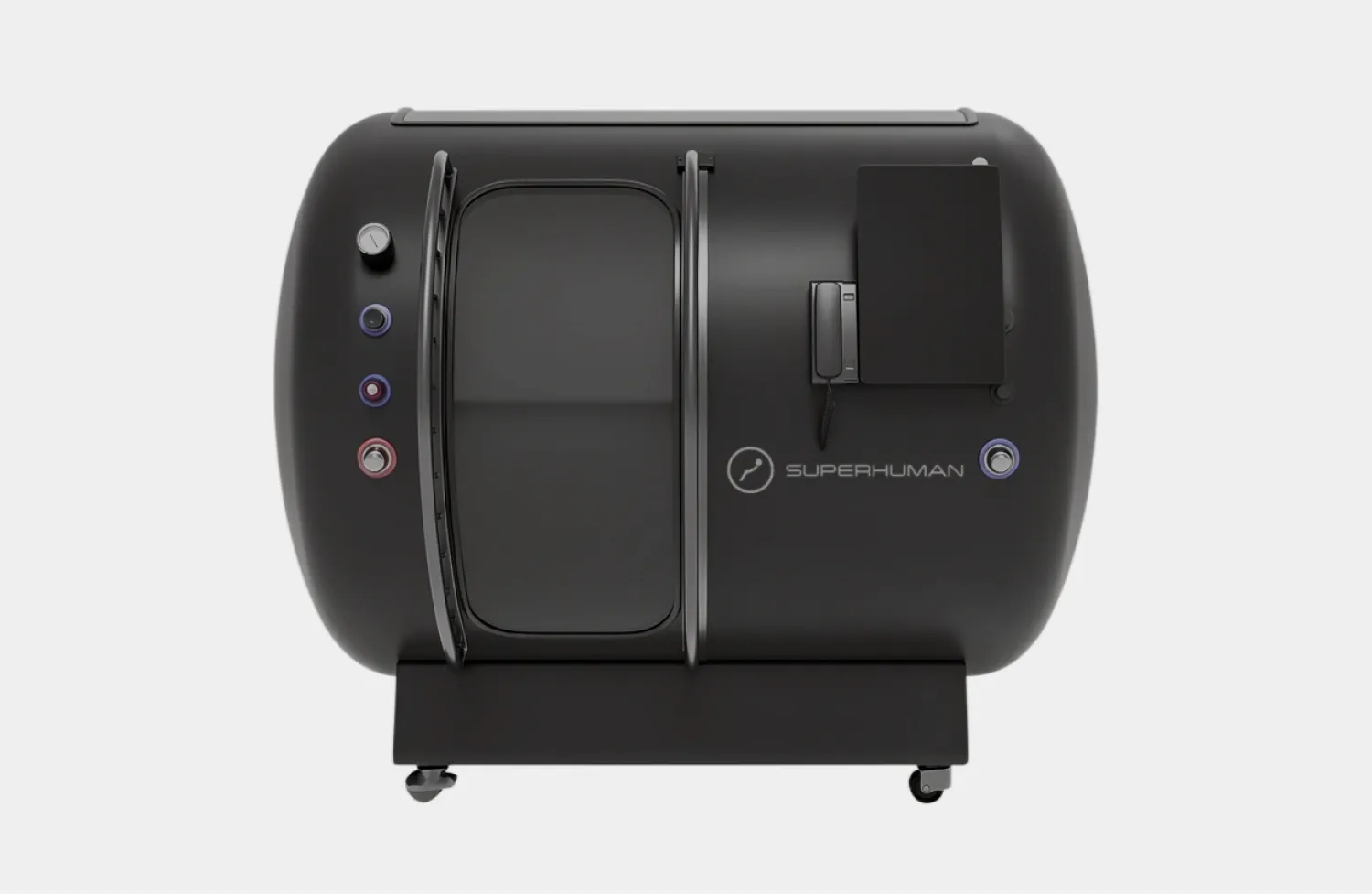
Superhuman T2: 2.0 ATA hard-shell, ASME and PVHO-1 tested, built in an ISO 13485 medical-device facility
Superhuman T2, from $125,000 →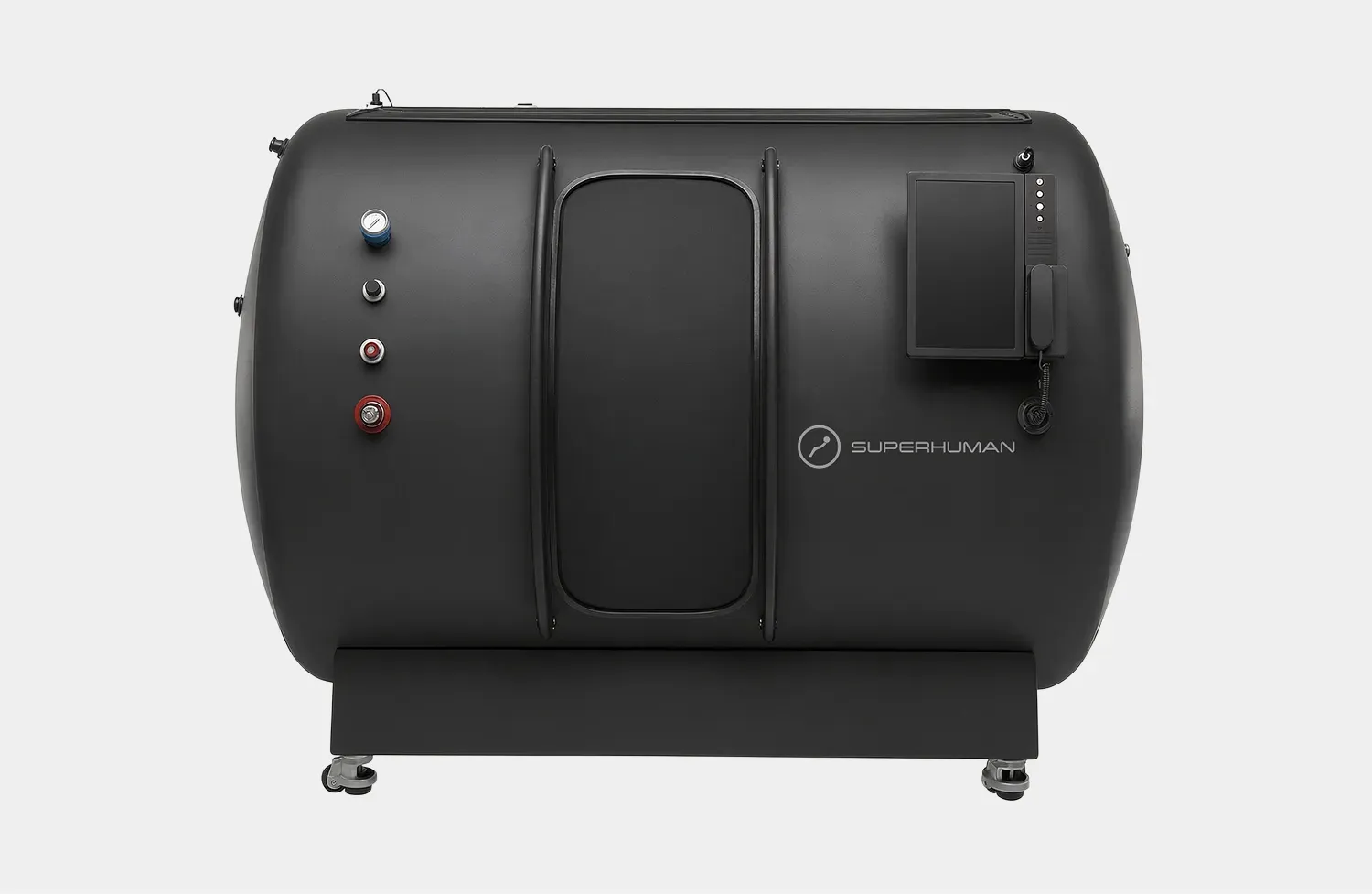
Superhuman T4: 2.0 ATA hard-shell for four occupants, ASME-certified vessel, clinical-scale throughput
Superhuman T4, from $169,000 →Scoping a chamber for a clinical or wellness operation? Book a consultation, or see the numbers in our financing and payments guide. For anything related to PTSD care itself, the path runs through a physician and a mental-health team, not through equipment of any class.
Before the first session
Safety, and the week that gets hard
HBOT's general safety profile is well characterized and manageable in screened patients. PTSD adds one consideration that deserves plain language rather than a footnote.
The common side effects are mundane: ear barotrauma during compression, sinus pain, temporary vision changes across long courses, fatigue, and claustrophobia. Serious events are rare in screened patients; oxygen-toxicity seizures are the one the literature tracks, and the one absolute contraindication is an untreated pneumothorax. The 2026 meta-analysis pooled adverse events across 17 studies and found them mild and transient, mainly ear discomfort and brief anxiety (PMID 42169234). The full contraindication picture is in our chamber safety guide and the side effects and contraindications guide.
The PTSD-specific point is emotional intensification during treatment, and it shows up from three independent directions. A 2024 review reported severe but reversible emotional worsening in 30–39% of subjects at the highest oxygen doses (PMID 38882688); the first US military study saw transient symptom deterioration in 4 of 16 participants (PMID 22026588); and the Israeli team itself warns clinicians that suppressed memories can resurface mid-course, producing temporary anxiety, irritability, or low mood before improvement (Psychiatric Times). Read carefully, this is not a reason for fear; it is a reason for setting. The studied programs run with trauma-trained teams who expect the hard week and know how to carry a patient through it. So the practical screening question for any clinic is simple: who on your team handles the hard week? A named mental-health professional is a good answer. A waiver is not.
Two boundaries are absolute. Acute crisis comes first: active suicidal intent, psychosis, or mania are exclusion criteria in the ongoing military trial and a reason for immediate professional care, not a chamber. And medication or therapy changes belong to the treating clinician, full stop. Screened, supervised, physician-led, with psychological support built in, or not at all.
For wellness operators
What you can say, and what you must not claim
Veterans and trauma survivors will walk through your door, because they are looking everywhere for help. How you handle that conversation defines your business more than any equipment choice.
| You can say | You must not claim | |
|---|---|---|
| Talking about PTSD | HBOT is not FDA-cleared for PTSD; it is an active research area with genuinely encouraging and genuinely null trials | That hyperbaric sessions treat, cure, or resolve PTSD or any mental-health condition. No outcome claims, ever |
| A veteran asks about your chamber | Listen, point them to their care team and to the published evidence, including the negative trials | Selling a session package as PTSD treatment, or quoting trial percentages as personal promises |
| Pressure honesty | State your chamber's rated pressure and that the studied protocols used 1.5–2.0 ATA with 100% oxygen under medical supervision | Citing PTSD trial results as if they were produced in your studio's protocol |
| If a client is struggling | Treat any mention of suicidal thoughts as real: 988 (Veterans Crisis Line, press 1) and their clinician | Positioning the chamber as an answer to a mental-health crisis. There is no version of this that is acceptable |
One script covers the conversation that matters most. "I served two tours and nothing has touched my PTSD. Will this help me?" The honest answer: nobody gets to promise that. The research is genuinely encouraging in places and genuinely null in others, this use is not FDA-cleared or covered, and the people who ran the positive trials would tell you the same thing: this is a medical conversation to have with your care team, and here are the studies, including the negative ones, to bring to it. An operator who says that out loud will lose some sales and keep every bit of trust. In this market, and with this population, trust is the only asset that compounds.
The access map
For veterans and families: money, coverage, and how to vet a clinic
If you are researching this for yourself or for someone you love, you are doing exactly the right thing: reading before spending. Here is the landscape the clinic brochures skip.
What the VA does and does not cover
The VA does not provide community HBOT for PTSD or TBI as routine care. Asked directly in 2026, a VA spokesperson pointed to the FDA position: HBOT has neither been approved nor cleared for traumatic brain injury or PTSD, and the VA "continues to review emerging research" (quoted by the Special Operations Association of America). The VA's own 2018 evidence brief reached the same place: case-series enthusiasm, controlled-trial disappointment, no support for routine use, with a trial of HBOT defensible after established options have been tried. Some VA sites have offered HBOT to limited numbers of veterans case by case; it is worth asking your VA care team directly rather than assuming either answer.
State programs and the bill in Congress
The gap has produced a grassroots funding map most vendors never mention. According to the advocacy coalition TreatNOW (their figures, worth verifying in your own state), 14 states have passed laws supporting veteran HBOT access, seven have assembled roughly $33 million in funding, and Kentucky's program ($1.5 million through 2028) is treating veterans now. At the federal level, H.R.1336, the Veterans National Traumatic Brain Injury Treatment Act, would direct the VA to run a five-year HBOT pilot for veterans with TBI or PTSD; it passed the House Veterans' Affairs Committee in May 2025 and awaits a floor vote, with a Senate companion bill filed. None of this is coverage yet. It is movement worth tracking, and your representative's office is the honest place to ask.
The free route most people miss: clinical trials
Recruiting studies offer HBOT at no cost, inside a monitored protocol, which is simultaneously the cheapest and the most scientifically useful way to try it. The most important one right now is the Israeli Defense Forces' pragmatic randomized trial (NCT07473362): 72 participants, two pressure protocols, two years of follow-up, and the first major PTSD trial to include women. US registries are recruiting too; current listings are searchable on ClinicalTrials.gov.
How to vet a clinic, and the red flags
The questions that separate serious programs from marketers: which protocol, exactly (pressure, oxygen percentage and delivery, minutes at pressure, total sessions), and which trial justifies any deviation from the studied doses. What chamber class: hard-shell with 100% medical oxygen, or a soft concentrator setup. Who is the physician, and who handles the hard week if memories intensify mid-course. The total cost in writing, including what happens if the first block "almost works." And the tell: how do they read the null military trials? A provider who knows Wolf, Cifu, and HOPPS has done the reading; one who has never heard of them has not. On the claims side: "the VA will pay for it" is false outside specific state programs (one national clinic chain says it outright; the VA's own statement above is the record). "52% of veterans cured" traces to a small, unblinded study by a clinic owner (the actual paper) and cannot carry that word. Guaranteed outcomes fail the basic test: the literature reports averages across small groups, never certainties for individuals.
Last, and said with care: the reason you are reading this page is that standard care has not been enough, for you or for someone you would do anything to help. That is a legitimate place to stand, and the research genuinely justifies watching this field. If things are heavy right now, the Veterans Crisis Line is 988 (press 1), call or text, any hour, no paperwork. The science will still be here tomorrow.
Honest edges
Limitations and open questions
The encouraging evidence is real and so is everything that tempers it. Both halves deserve the same clarity.
On the positive side's ledger, the weaknesses are structural. The controlled positive data cluster in one research group with a commercial arm, and the flagship trial studied only men without brain injury, a narrower population than the one actually seeking treatment. The two-year durability data come from an uncontrolled follow-up of 22 people. The first US dataset is encouraging and entirely without a control group. And the independent military record, in populations where PTSD and brain injury travel together, produced null between-group results, plus one short-term signal that faded by six months.
On the other side of the ledger, the nulls have their own limits. The military trials were designed for postconcussion symptoms, not PTSD; their sham design is contested; their own pooled re-analysis found trends and a dose-response hint favoring oxygen (PMID 31394604); and the 2026 meta-analysis found the positive pattern concentrated exactly where the methods were cleanest. "The independent trials were null" and "the best trial was positive" are both true statements. The field has not yet run the study that reconciles them.
What would settle the question is known: independent, multicenter, true-sham trials in defined PTSD populations, with standardized outcomes and follow-up measured in years, including women and the comorbid-TBI majority. The IDF trial now recruiting answers some of that (dosing, durability, women) though not the sham question. Until those data land, the honest posture is the one this page has tried to hold: promising, actively researched, not yet proven, and absolutely not a reason to abandon care that works. And whatever the verdict becomes, it will be decided at medical-grade pressure with 100% oxygen under physician supervision, the dose class every trial used. That context is why we publish pages like this as a chamber manufacturer, and it is the same context that forbids us from promising anyone an outcome. For the indication where HBOT is established, covered, and guideline-backed, see the sibling wound healing and HBOT pillar; for the closest research neighbor, the TBI evidence page; and for the stroke version of this same honest format, the stroke recovery pillar.
FAQ
PTSD and HBOT questions
Is HBOT FDA-approved for PTSD?
No. Hyperbaric chambers are FDA-cleared for 13 indications (carbon monoxide poisoning, decompression sickness, non-healing diabetic wounds, radiation injury, and others), and PTSD is not among them, nor is any psychiatric condition. Every PTSD use of HBOT in the United States is off-label, and the FDA has issued a consumer bulletin warning about clinics marketing HBOT for unapproved uses. Off-label does not automatically mean illegitimate; it means the evidence, not a regulator, has to carry the conversation. This page exists to lay out that evidence, encouraging and discouraging alike.
Does insurance, Medicare, or the VA cover HBOT for PTSD?
No. Medicare's National Coverage Determination 20.29 covers hyperbaric oxygen therapy only for its listed indications, and PTSD is not one of them; commercial insurers follow the same line. The VA does not provide community HBOT for PTSD as routine care, and said so in plain terms in 2026: the FDA has neither approved nor cleared HBOT for TBI or PTSD. The exceptions worth knowing about: veteran advocacy groups count at least 14 states with their own HBOT programs or funding for veterans (Kentucky's is a working example), a federal bill directing the VA to run a five-year HBOT pilot passed a House committee in May 2025, and some VA sites have offered HBOT to limited numbers of veterans case by case. Any clinic that tells you the VA will simply pay for your course is misstating the position.
What did the biggest trial actually show?
The 2024 Journal of Clinical Psychiatry trial randomized 63 male combat veterans with treatment-resistant PTSD to 60 sessions of 100% oxygen at 2.0 ATA or a carefully matched sham. Average CAPS-5 scores in the HBOT group fell from 42.6 to 25.8, a clinically meaningful drop, and stayed down at follow-up, while the sham group's scores rose from 45.1 to 49.2. Brain imaging showed improved connectivity alongside the clinical change. It is a genuinely strong result. The honest caveats travel with it: one research group produced it, that group's commercial arm sells the protocol, only men without brain injury were studied, and no independent team has replicated it yet. The evidence section above maps every trial, including the ones that found nothing.
How many sessions does a course take, and what does it cost?
The studied protocols are long courses: 60 daily sessions of 90 minutes over 12 weeks in the Israeli trials, or 40 sessions of 60 minutes over 6 to 12 weeks in the US studies, five days a week in both cases. Because PTSD is not a covered indication, the market is cash-pay. The veteran advocacy coalition TreatNOW puts session prices at roughly $230–450, which makes a full course a five-figure commitment before travel and time away from work, and no US clinic we reviewed publishes an all-in price. One 2026 Israeli military study found improvement plateaued around weeks 6 to 8, which raises a fair question to ask any provider selling 60 or more sessions: what evidence supports the length of the course you are quoting me?
Is a soft home chamber the same treatment the trials used?
No. Every controlled PTSD trial used a hard chamber pressurized to 1.5–2.0 ATA while the patient breathed 100% medical oxygen through a mask, with medical staff present. Soft portable chambers top out around 1.3 ATA and are typically paired with an oxygen concentrator rather than 100% oxygen; the resulting dissolved-oxygen dose is a fraction of the studied one, and the 2026 meta-analysis found benefit at 2.0 ATA but not at 1.2 ATA. Soft chambers also hold FDA clearance only for acute mountain sickness. A mild-pressure home session is a different dose, not a cheaper version of the studied one, and no PTSD trial supports it.
Should HBOT replace therapy or medication for PTSD?
No, and the researchers behind the positive trials say so as clearly as the skeptics do. Trauma-focused psychotherapies (EMDR, trauma-focused CBT) and guideline medications are the first-line treatments, and they help many people. HBOT is being studied as an adjunct for the substantial minority who remain severely symptomatic after adequate standard care, and even its leading proponents describe it as a complement to psychological treatment, not a substitute. Anyone considering stopping medication or pausing therapy to try HBOT should make that decision with their treating clinician, not with a chamber provider. And anyone in crisis should reach out now: call or text 988 (Veterans Crisis Line, press 1), available around the clock.
Last updated: September 2026. This guide is educational and is not medical advice. Hyperbaric oxygen therapy is not FDA-cleared for PTSD, and any PTSD use is off-label. PTSD is a serious, treatable medical condition: trauma-focused therapy and medication are the first-line treatments, and any HBOT decision belongs with your treating clinicians. If you are in crisis, call or text 988 (Veterans Crisis Line, press 1), available around the clock.